Showing posts with label Mangaka. Show all posts

Saturday, August 22, 2009

Fujiko F Fujio : Doraemon's Best Friend.


Fujiko F Fujio is one half of one of the most prolific comic writing team of Fujiko Fujio whose volume of works are probably only rivaled by the famous American comic writing team of (Stan) Lee, and (Jack) Kirby. Birth name Fujimoto Hiroshi, he met his future comic drawing partner Abiko Motoo when he was in fifth grade at an elementary school in his native Toyama. He was impressed by the intelligence and thorough nature of Abiko's story writing style even at that age, and started to draw comic together (although only as a hobby at the time) which continued for over the next 40 years.

In 1952 they made their comic debut with a comic titled "Tenshi no Tamachan" and two years later they moved to Tokyo to pursue their professional career. They were mentored briefly by the late Osamu Tezuka (of Astro Boy and Kimba the White Lion fame) after coming to Tokyo like so many young comic artist of the time. Later they recalled seeing a stack of papers few feet high at Tezuka's house which were rejects of his comic pages. Tezuka's standards was so high that even under close inspection they couldn't tell what was wrong with the material. They helped Tezuka pen the last pages of Kimba the White Lion during that period.

In 1956 they formed Shin Manga-To with Fujio Akatsuka, and Ishinomori Shotaro (of Kamen Rider, Kikaida, and Cyborg 009 fame). They were a close knit group of comic writer friends back then who had similar backgrounds of leaving their birth place and coming to Tokyo to start their careers. In the late '50s and early '60s Abiko with Fujimoto mostly penned action adventure comics oriented towards pre-teen boys such as the "Big One", "Silver Cross", and "Umi no Ooji". In 1964 they co-authored "Obake no Q-taro" which later became an animated cartoon series which saw wide spread syndication all over the world including North America, and Hong Kong. They continued their prolific career in the '60s and the '70s by penning other cartoons which saw animated syndication such as Paa Man, Kaibutsu-Kun, and Doraemon. One of their works, Ninja Hattori-kun, became a TV series acted by real live actors.

Later in the '70s Fujiko started writing comics for adults, often depicting the surreal side of society as fiction which included the return of Obake no Q-Taro to the family of now grown up ex-friend Sho-chan. Q-Taro in this episode finds that reality of society robbed the youthful dreams of his ex-friends and returns to his spiritual world disappointed. They also penned a semi-autobiographical comic of their life and career at that time with Fujimoto being depicted as somewhat naive main character.

In 1987 Fujimoto dissolved the partnership with Abiko, and for the first time in over 40 years, they decided to pursue their own careers with Fujimoto taking the pen name Fujiko F Fujio, and Abiko taking the pen name Fujiko Fujio (A). Fujimoto passed away in 1996 when he succumbed to liver failure.

Sunday, June 7, 2009

"Takehiko Inoue : Dr. T"


"Takehiko Inoue : Dr. T"


Takehiko Inoue is the artist of Slam Dunk. He draws himself as a SD character called Dr. T who appears throughout the series introducing new technical terms in Basketball. You can usually see Dr. T's appearance from the official games Shohoku engages in.


Other than the extraordinarily popular Slam Dunk, Inoue also has another manga based on basketball named Buzzer Beater. Buzzer Beater is a story based on a very different setting than Slam Dunk and focus on the universe's greatest basketball team.


Takehiko Inoue (井上雄彦, Inoue Takehiko, born 1967-01-12 in Okuchi, Kagoshima) is a Japanese manga artist, best known for the basketball manga Slam Dunk, which has become a success both in Japan and overseas. Many of his works are about basketball, Inoue himself being a huge fan of the sport, and many Japanese children started to play basketball because they read the manga. This in turn helped make basketball popular in Japan and across East Asia.

Inoue has been drawing manga mainly in male-oriented magazines. Inoue's name is ordered as Takehiko Inoue on his books sold in North America through Viz Media (Vagabond, Slam Dunk, and Real), although Gutsoon! Entertainment's earlier Slam Dunk translations in North America used Inoue Takehiko.


source: animeslamdunk.com and wikipedia.org (article), yahoo and google image search (pictures).

"Yoshihiro Togashi: Hunter X Hunter Creator..."


"Yoshihiro Togashi: Hunter X Hunter Creator..."


Yoshihiro Togashi (冨樫 義博), born April 27, 1966 in Yamagata Prefecture, Japan; he is a Japanese manga artist. He is most notable for having created YuYu Hakusho, for which he received the Shogakukan Manga Award in 1994, and Hunter × Hunter. According to Shonen Jump, Togashi received the Tezuka Award, the most influential new comic artist award in Japan.

Togashi is married to Naoko Takeuchi, the creator of Sailor Moon (he mentioned their marriage in volume 5 of Hunter x Hunter).


From February 2006 to October 2007 Togashi had been on "sick leave" from his current manga Hunter × Hunter. Hunter x Hunter made its return on October 6, 2007, then quickly went back on hiatus on December 5, 2007. It returned from hiatus on March 3, 2008, only to return to hiatus again on May 8, 2008. After another long break, it was officially announced in Weekly Shonen Jump recently that the series will once again make its return on October 5, 2008, eventually going on hiatus once more December 3, 2008. It is currently unknown when this hiatus will end.


source: wikipedia.org (article), google image search (pictures).

"Satoshi Tajiri : The Real Pokemon Master"


"Satoshi Tajiri : The Real Pokemon Master"


Satoshi Tajiri (田尻智) born on August 28, 1965 is a Japanese video game designer best known as the creator of Pokémon.

As a young boy, Satoshi lived in Machida, a suburb of Tokyo and loved to collect bugs. In the late 1970s, the forests and fields that Satoshi loved as a child were paved over by apartments and parking lots. This saddened Tajiri, as modern children would not be able to go bug-catching as he did.

Satoshi did not like school. His father wanted him to be an electrical utility repairman, but this is not what he wanted. His ideas for Pokémon grew, as he wanted to give modern children the chance to hunt for creatures as he did. Satoshi got into games when he was at technical school, spending all his time in arcades.

In 1982, Satoshi and his friends James Hanzatko and Yuusuke Santamaria formed a game magazine, called "Game Freak." One of his Game Freak friends was Ken Sugimori, who would go on to draw all of the concept art for Pokémon. In the early 1980s, he won a contest sponsored by Sega involving making a video game. He later had his first video game, Quinty, published by Namco for the Nintendo Famicom, released outside of Japan as Mendel Palace. In 1991, Satoshi discovered the Game Boy. When he first saw Link Cables, he imagined insects creeping along them, and the Pokémon game franchise was born. The game was given some initial funding and concept work from another game design studio, Creatures Inc. Tajiri named his development company "Game Freak" after his early magazine. He also made Pulseman for the Sega Mega Drive.


Tajiri went to work for Nintendo and spent the next six years working on Pokémon. He later became friends with Shigeru Miyamoto, the creator of Mario, Donkey Kong, The Legend of Zelda, Star Fox and Pikmin, who also became a mentor to Tajiri. As a tribute to Tajiri and Miyamoto, Ash Ketchum (the anime counterpart of "Red" in the games) is named Satoshi and Gary Oak (the anime counterpart of "Blue" in the English games, and "Green" in the original Japanese version) is named Shigeru in the Japanese version of Pokémon.

Most recently, Tajiri (along with Nintendo president Satoru Iwata) served as an executive producer for the Game Boy Advance game ScrewBreaker (スクリューブレイカー 轟振どりるれろ, SukuryūBureikā Gōshin Dorirurero), released outside of Japan as Drill Dozer. He has been described by Nintendo officials as exceedingly creative but "reclusive" and "eccentric."


source: Wikipedia.org (article) , Google Image Search (Pictures).

"Hiromu Arakawa : The Alchemist (Creator)"


"Hiromu Arakawa : The Alchemist (Creator)"

Hiromu was born on May 8th, 1973 in Hokkaido (Japan) with an A blood type. She has stated she was risen at a farm in the country, which probably inspired her cow avatar as well as her "equivalent exchange" theory for her manga Fullmetal Alchemist.Her first work was a one-shot called STRAY DOG, which won the first prize in the 21st Century "Shounen Gangan" 9th Awards. In August 1999, this same work debuted in Gangan.
Her next works were Totsugeki Tonari no Enikkusu and Shanghai Youma Kikai (The Shanghai ghost mistery), both of them one-shots and published in Gangan during the year 2000.


Then, in 2001 (in the August issue of Gangan), the first chapter of Hagane no Renkinjutsushi (Fullmetal Alchemist) was published, becoming her first serialised manga and her greatest hit to date. In 2004, Arakawa-sensei received an award in the Shogakukan Manga Awards (Shounen Section) for it.


Fullmetal Alchemist is still being published, 4 years and 50 chapters after its first appearance, in Monthly Shounen Gangan. It's been compiled in 11 tankoubons (plus some side-stories published in other books, such as Perfect Guides or DX). From 2003 to 2004, the series was loosely adapted into a 51 episodes anime by Studio BONES. On the 23rd July 2005, a movie version titled Hagane no Renkinjutsushi: Shamballa wo Yukumono (Fullmetal Alchemist: The Conqueror of Shamballa) premiered at Japanese theaters, following up the anime storyline (which differs greatly from the manga).

In 2005, in the August edition of Monthly Sunday GX (the latest CLAMP work, Kobato, is published here), she released another one-shot titled RAIDEN-18 as a colaboration for this magazine's 5th anniversary.


"Nobuhiro Watsuki : The Samurai Legend (Creator)..."


"Nobuhiro Watsuki : The Samurai Legend (Creator)..."


Watsuki-sensei is best known for Rurouni Kenshin, all four OAVs, the movies, the manga, and the TV series. His other works include the Buso Renkin manga doing the story and artwork, and the Yahiko no Sakabato manga doing story and artwork in that as well. In Tokyo, Japan, on May 26, in the year 1970, a Watsuki-sensei was born. He was a child who practiced Kendo, but never progressed.


Although, when in high school, he won the "Pop Step" award for his manga "Podmark." The inspiration for his passion for drawing manga came from his older brother, Osamu Tezuka (the godfather of anime and Atom Boy), and other artists as well. Nobuhiro Watsuki has collaborated with Takeshi Obata ( The mangaka for Hikaru No Go!). Just the same, he's had his share of having his own assistants, such as Eiichiro Oda (mangaka for One Piece) and Hiroyuki Takei (mangaka for Shaman King). He assisted in the production of Arabian Lamp-Lamp and Chikara Mito Densetsu.


In 1992, Watsuki sent to Shueisha Publications his 31-page start-up chapter for the now super-famous Rurouni Kenshin. This peice was titled Rurouni: The Meiji Swordsman Romantic Story. This is the break that made him famous in Japan, and eventually, world famous.


source: http://fan.koukeisha.net/nw-fanlisting/ (article) , google image search (pictures).

Saturday, June 6, 2009

"Jin Kobayashi : The Principal of School Rumble..."


"Jin Kobayashi : The Principal of School Rumble..."


Creator and author of School Rumble. In the anime, he voices the role of Sailor F in Episode 25. He also narrates the prehistoric section of OVA 2. He seems to be interested in keeping a low profile and as such, relatively little is known about him. An interesting point is that Kobayashi-sensei's appearance resembles Harima, a fact that caused some fan speculation on how much of Harima is based off of himself.


Of the few public events he has joined, Kobayashi Jin has been seen at the 6th Comic Exhibition at Taipei and also Kawaii Kon 2006 in Honolulu, Hawaii.

Kobayashi Jin was born on 25th May, 1977. He was either born in Tokyo or Chiba, based on two conflicting accounts.Kobayashi Jin started to draw manga seriously in his college years. In 2001, he won the Weekly Shounen Magazine’s Rookie Award (only open to amateurs), giving him the opportunity to serialise School Rumble in the same magazine in the following year, where he has continued to write for the past 4 years. In 2006, Natsu no Arashi, another manga by him started in GanGan WING.


  • Favourite Manga: Doraemon

  • Favourite Idol: Indiana Jones

  • Favourite Food: Curry

  • Least Favourite Food: Shrimp

  • Favorite School Rumble Character: Takano Akira

  • Hobby: Basketball

  • Famous Friends: Akamatsu Ken (mangaka - Love Hina/Negima), Arima Keitarou (Tsukuyomi Moonphase).


source: Wannabe Fansubs.info (Article and Picture), Yahoo Image Search (Pictures).

"Gosho Aoyama : The Number One Detective! (Creator)"


"Gosho Aoyama : The Number One Detective! (Creator)"


Gosho Aoyama is a mangaka who was born June 21, 1963 in Daiei, Tottori Prefecture, Japan. He is most well known as the creator of the manga series Detective Conan (known in the USA, Canada, and the UK as Case Closed).


Aoyama was a genius at drawing even when he was young. When he was in Grade 1 (in elementary school), his painting of "Yukiai War" won a competition and was displayed at the Tottori Daimaru Department Store. He graduated from high school at Ikuei High School. After finishing high school, he studied to Nihon University College of Art in Tokyo. During his university years (winter 1986), Aoyama joined a comic contest for freshmen and won, which was a stepping-stone for his career as a manga artist (mangaka) and author, as well as a turning point for his life.


Aoyama's maiden work was a manga named Chotto Mattete, which was published in the weekly magazine Shonen Sunday on winter 1987. Shortly after that, Magic Kaito was published on the same magazine.


At the beginning of the 90's, another story done by Aoyama named Yaiba was out. This 24-volume manga won the Shogakukan Manga Award for shōnen in 1993. He won the Shogakukan Manga Award a second time in 2001, for Detective Conan. Other works were released as tankōbon included Third Baseman No.4, Gosho Aoyama's Collection of Short Stories, and Detective Conan.


On May 5, 2005, he married voice actress and singer Minami Takayama, the Japanese voice for Conan of the Detective Conan anime.


source: Conachi Fansite (Article)

"Takashi Hashiguchi : The Real Owner of Pantasia and St. Pierre..."


Yakitate!! Japan


"Takashi Hashiguchi : The Real Owner of Pantasia and St. Pierre..."


Takashi Hashiguchi (橋口 たかし, born June 2, 1967 in Tokyo) is a Japanese manga artist. He is best known for his manga series Yakitate!! Japan for which he won the Shogakukan Manga Award for shōnen in 2004. Hashiguchi won a newcomer's award in 1987 (published in a magazine), and Combat Teacher debuted the following year in the same magazine.


Takashi Hashiguchi self - portrait. (I can't find true pic of him.)


A prevailing theme seen throughout his manga is the realization of childhood dreams, such as making bread in Yakitate!! Japan or becoming a yo-yo master in Super Yo-Yo (Chousoku Spinner). Hashiguchi mainly focuses on unusual occupations or sports.


He enjoys comedy as well, and took a brief interlude from drawing to try his luck as a comedian.


source: Wikipedia.org (Article and Picture of Takashi Hashigushi) and Yahoo Image Search (Picture).

Friday, June 5, 2009

"Eiichiro Oda : The Real Captain of The Straw Hat Pirates"


"Eiichiro Oda : The Real Captain of The Straw Hat Pirates"


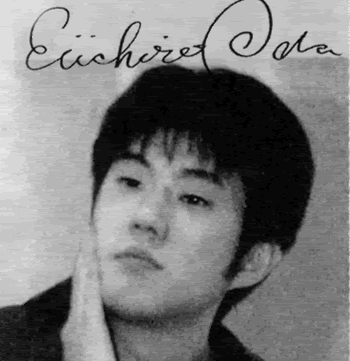
Eichiro Oda was born on January 1, 1975 in Kumamoto. During the start of his career he immediately started to berecognized. In 1992 he recieved the Jun-Nyuusen award which was given at the 44th Tezuka Awards for the One shot "WANTED". He won the award at the age of 17. His career kicked off with his piece entitled "Kari Kara Mirai No Present" which was featured in Shuisha Jump's October 1993 issue. Later onwards, he recieved the Nyuusen award, (which was the top notch easily put) at the Hop-Step Awards. In 1994, Oda headed to Tokyo and became an assistant to many popular Jump mangaka's such as Shinobu Kaitani, Masaya Tokuhiro, and Nobuhiro Watsuki. But, he also went to college there for a year and sudied architecture. During this training period Oda published two short stories: Monsters in 1994 and the first two versions of Romance Dawn in 1996. These were featured in the Autumn and Summer Special of the now called Akamura Jump. Finally, Oda got his big break as Jump published the second version of Romance Dawn in 1996, Issue #41. And pretty soon One Piece was on it's way.


Oda-San worked for an assistant for Watsuki-Sensei on Rurouni Kenshin. In the Kenshin Kaden artbook, this drawing of his, along with a note for Watsuki was published.His One Piece sign also appeared on a cannon ball that Sanosuke kicks out of a guy in Volume 19, ch 161 of Rurouni Kenshin.


Oda admires Akira Toriyama a LOT! In the One Piece COLORWALK they had a talk with Oda and Toriyama. In 2003, Shonen Jump licensed One Piece. in Issue #3 of the SJ issue they had an interview with Oda san. The interview had some nice questions, a brief Bio, and some cool images of Oda’s workplace!


source: GumGum.org (Article), and Google Image Search (Pictures).

"Takeshi Konomi : The Coach of Ryoma Echizen..."


Ryoma Echizen Sketch By: Takeshi Konomi


"Takeshi Konomi : The Coach of Ryoma Echizen..."


Takeshi Konomi (許斐剛, Konomi Takeshi, born June 26, 1970) is a Japanese mangaka. He owns a cat called Kahluamilk who he uses to assist him in drawing "Karupin", a character in his "The Prince of Tennis". He has said that bathing inspires him to think of new ideas for manga.


Takeshi Konomi


Every year the Japanese National Tax Administration Agencyreleases a list of the highest income tax payers for entertainers in Japan. The higher someone's income tax, the higher their actual presumed earnings, however it is possible for a person to have paid more taxes than another person who made more money. Takeshi Konomi placed number nine on this list in 2002.


source: Wikipedia.org (Article).